Perturb-seq Tutorial (R)#
The original data of Jin et al 2020 can be downloaded from the Broad single cell portal (https://singlecell.broadinstitute.org/single_cell/study/SCP1184). Here, we just use a subset of the data to demonstrate the workflow of the analysis.
library(Seurat)
## Loading required package: SeuratObject

## Loading required package: sp

##
## Attaching package: 'SeuratObject'

## The following objects are masked from 'package:base':
##
##     intersect, t
sc.seurat <- readRDS("perturbseq-exneu.rds")

# Access the counts through Seurat when its installed version recognizes the
# serialized Assay5 object; otherwise recover the same layer and dimnames
# directly. The fallback keeps this tutorial runnable with older Seurat builds.
if ("RNA" %in% Assays(sc.seurat)) {
  counts <- GetAssayData(sc.seurat, assay = "RNA", layer = "counts")
} else {
  rna.assay <- sc.seurat@assays[["RNA"]]
  counts <- rna.assay@layers[["counts"]]
  rownames(counts) <- rownames(rna.assay@features)
  colnames(counts) <- rownames(rna.assay@cells)
}
Y <- data.frame(t(as.matrix(counts)), check.names = FALSE) # cell-by-gene matrix
metadata <- sc.seurat@meta.data

perturb <- metadata
colnames(perturb) <- gsub("Perturbation", "trt_", colnames(perturb))
perturb$trt_ <- relevel(as.factor(perturb$trt_), ref = "GFP")
A <- data.frame(
  model.matrix(~ trt_ - 1, data = perturb)[, -1, drop = FALSE],
  check.names = FALSE
) # cell-by-trt matrix; remove the first (GFP control) column
colnames(A) <- sub("^trt_", "", colnames(A))
For running causarray, we require the following inputs:
Y: the cell-by-gene gene expression matrix.A: the cell-by-condition binary matrix of the perturbation/treatment conditions.X, X_A: (optional) the cell-by-covariate matrix of the covariates of interest for outcome and propensity models.
Here, Y and A can be dataframes.
Use R package reticulate to load the Python package causarray.
Render this tutorial from the causarray-r environment defined by
environment-r.yaml; reticulate then connects to the NumPy-2-based
Python causarray environment.
require(reticulate)
## Loading required package: reticulate
Sys.setenv(PYTHONUNBUFFERED = TRUE)
use_condaenv('causarray')
causarray <- import("causarray")
cat(causarray$`__version__`)
## 0.0.9
# (Y, A) should be either data.frame or matrix
# optional covariates can be provided as matrices
dat <- causarray$prep_causarray_data(Y, A)
names(dat) <- c("Y", "A", "X", "X_A")
list2env(dat, .GlobalEnv)
## <environment: R_GlobalEnv>
We first apply gcate to estimate unmeasured confounders.
r <- 10
# Same early-stopping settings as the Python tutorial, so both produce
# identical latent factors on this dataset.
res_gate <- causarray$fit_gcate(
  Y, X, A, r, verbose = TRUE,
  kwargs_es_1 = list(rel_tol = 2e-4, max_iters = 30L),
  kwargs_es_2 = list(rel_tol = 2e-4, max_iters = 30L)
) # a list of results from 2 stages optimization
## {'d': 30, 'n': 2926, 'p': 3221, 'r': 10}
## 'Estimating initial latent variables with GLMs...'
## 'Fitting nb GLM (fast)...'
## 'Estimating initial coefficients with GLMs...'
## 'Fitting nb GLM (fast)...'
## {'kwargs_es': {'max_iters': 30,
##                'patience': 5,
##                'rel_tol': 0.0002,
##                'tolerance': 0.0,
##                'warmup': 0},
##  'kwargs_glm': {'disp_glm': array([ 1.11673516,  1.06870944,  1.16716468, ..., 12.58818245,
##        16.46897663,  1.70852614], shape=(3221,)),
##                 'family': 'nb',
##                 'size_factor': array([0.53193358, 0.87362742, 1.2235467 , ..., 0.5593801 , 0.73025856,
##        0.77857223], shape=(2926,))},
##  'kwargs_ls': {'C': 1000.0,
##                'alpha': 0.1,
##                'beta': 0.5,
##                'max_iters': 20,
##                'recheck_interval': 10,
##                'sparsity_boost': 2.0,
##                'sparsity_threshold': 0.5,
##                'tol': 0.0001,
##                'tol_cell': 0.0001,
##                'tol_gene': 0.0001,
##                'warmup_iters': 0}}
## 'Fitting GCATE (step 1)...'
## {'d': 30, 'n': 2926, 'p': 3221, 'r': 10}
## {'kwargs_es': {'max_iters': 30,
##                'patience': 5,
##                'rel_tol': 0.0002,
##                'tolerance': 0.0,
##                'warmup': 0},
##  'kwargs_glm': {'disp_glm': array([ 1.11673516,  1.06870944,  1.16716468, ..., 12.58818245,
##        16.46897663,  1.70852614], shape=(3221,)),
##                 'family': 'nb',
##                 'size_factor': array([0.53193358, 0.87362742, 1.2235467 , ..., 0.5593801 , 0.73025856,
##        0.77857223], shape=(2926,))},
##  'kwargs_ls': {'C': 1000.0,
##                'alpha': 0.1,
##                'beta': 0.5,
##                'max_iters': 20,
##                'recheck_interval': 10,
##                'sparsity_boost': 2.0,
##                'sparsity_threshold': 0.5,
##                'tol': 0.0001,
##                'tol_cell': 0.0001,
##                'tol_gene': 0.0001,
##                'warmup_iters': 0}}
## 'Fitting GCATE (step 2)...'
U <- res_gate[[2]]$U
# reticulate returns `hist` as an R list, so unlist() before min().
cat(sprintf("Step 1 -- epochs: %d, best NLL: %.6f\n",
            as.integer(res_gate[[1]]$n_iter), min(unlist(res_gate[[1]]$hist))))
## Step 1 -- epochs: 29, best NLL: 1.705777
cat(sprintf("Step 2 -- epochs: %d, best NLL: %.6f\n",
            as.integer(res_gate[[2]]$n_iter), min(unlist(res_gate[[2]]$hist))))
## Step 2 -- epochs: 29, best NLL: 1.722559
Next, we apply causarray to estimate the causal effects of perturbations on gene expression. Here the 106 GFP control cells and the perturbation groups (median 89 cells) are similar in size, so we use pooled variance to retain power in this relatively small comparison. This is a dataset-specific choice: unequal variance is preferable when the treated and control groups differ meaningfully in size or effective sample size, when outcome variability differs between the two groups, and for the Replogle and case-control tutorials.
offsets <- log(res_gate[[2]][['kwargs_glm']][['size_factor']]) # use the precomputed size factors
res <- causarray$LFC(Y, cbind(X, U), A, cbind(X_A, U), offset=offsets,
                    usevar="pooled", verbose=TRUE)
## 'Estimating LFC...'
## {'a': 29, 'd': 11, 'd_A': 12, 'estimands': 'LFC', 'n': 2926, 'p': 3221}
## {'offset': array([-0.63123664, -0.13510128,  0.20175377, ..., -0.58092607,
##        -0.31435661, -0.25029351], shape=(2926,)),
##  'random_state': 0,
##  'verbose': True}
## 'Fit propensity score models...'
## {'C': 1.0,
##  'class_weight': 'balanced',
##  'fit_intercept': False,
##  'random_state': 0,
##  'verbose': False}
## 'Fit outcome models...'
## 'Fitting nb GLM (fast)...'
## ('Fast GLM coefficients exceed bound (max|B|=1.53e+05 > 1e+04); falling back '
##  'to statsmodels...')
## 'Estimating dispersion parameter...'
## 'Fitting poisson GLM with offset...'
## 'Fitting nb GLM with offset...'
## 'Fitting GLM done.'
## 'Estimating AIPW mean...'
names(res) <- c("df_res", "estimation")
list2env(res, .GlobalEnv)
## <environment: R_GlobalEnv>
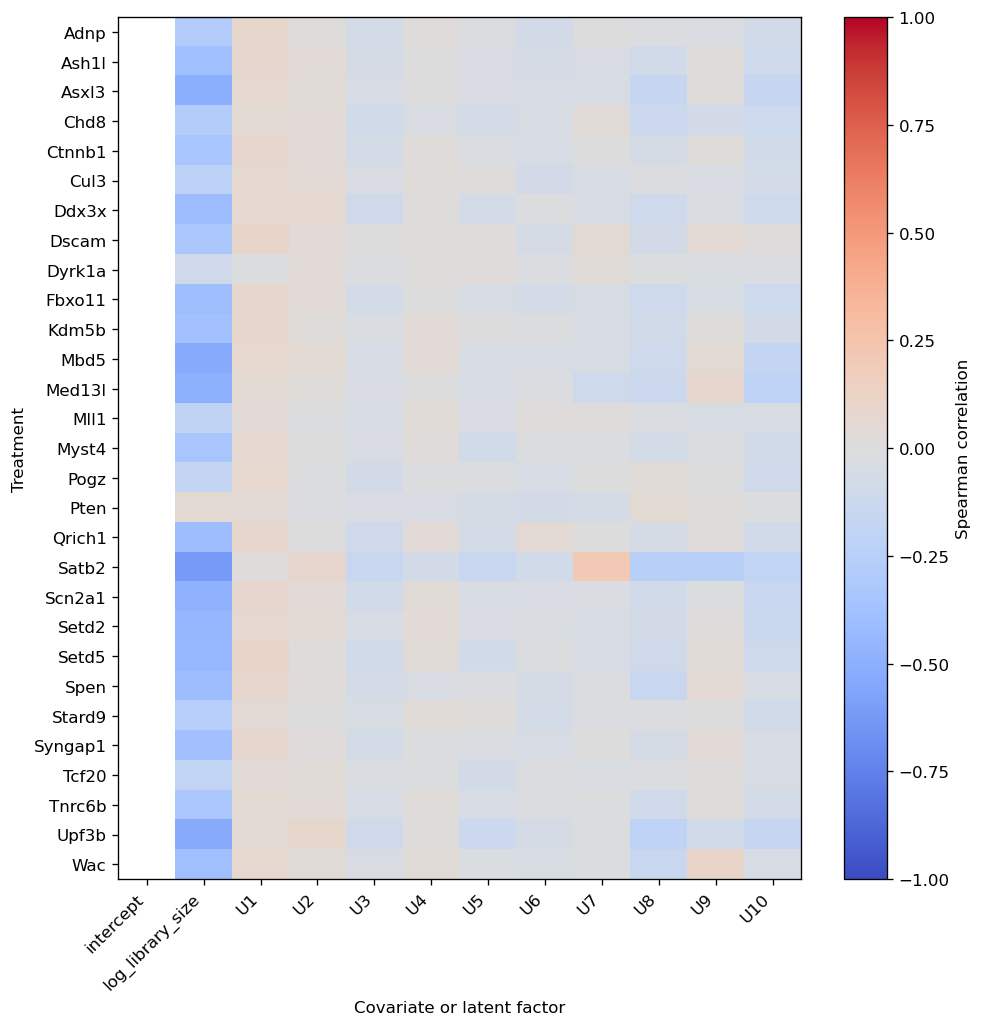
Diagnose treatment associations and overlap#
Positivity requires treated and control cells with comparable
covariates. The propensity design holds the observed covariates built by
prep_causarray_data (the intercept and standardized log-library size)
together with the estimated latent factors. The association summary
compares each perturbation with the shared all-zero GFP controls,
BH-adjusting across every treatment-by-covariate pair; pass
bh_scope = "per_treatment" to adjust within each treatment instead.
These are diagnostics only — association alone is not a reason to drop
an observed covariate.
W_A <- cbind(X_A, U)
factor_names <- paste0("U", seq_len(ncol(U)))
propensity_names <- c("intercept", "log_library_size", factor_names)
propensity_types <- c("observed", "observed", rep("latent", ncol(U)))

association_summary <- causarray$summarize_treatment_associations(
  A, W_A,
  covariate_names = propensity_names,
  covariate_types = propensity_types
)
observed_associations <- subset(
  association_summary, covariate_type == "observed" & !constant
)
observed_associations <- observed_associations[
  order(observed_associations$padj),
]
head(observed_associations, 10)
##     treatment        covariate covariate_type n_control n_treated spearman_rho
## 218     Satb2 log_library_size       observed       106        51   -0.6206012
## 134      Mbd5 log_library_size       observed       106       119   -0.5251680
## 26      Asxl3 log_library_size       observed       106       130   -0.5011708
## 326     Upf3b log_library_size       observed       106       100   -0.5244644
## 230    Scn2a1 log_library_size       observed       106        93   -0.4791687
## 146    Med13l log_library_size       observed       106        75   -0.4911242
## 242     Setd2 log_library_size       observed       106        76   -0.4504232
## 14      Ash1l log_library_size       observed       106       122   -0.3905315
## 254     Setd5 log_library_size       observed       106        71   -0.4383442
## 110    Fbxo11 log_library_size       observed       106       111   -0.3943441
##           pvalue         padj standardized_mean_difference constant
## 218 4.352985e-18 1.388602e-15                   -1.6704318    FALSE
## 134 2.377952e-17 3.792833e-15                   -1.1965476    FALSE
## 26  2.061826e-16 2.192409e-14                   -1.1478666    FALSE
## 326 5.917208e-16 4.718973e-14                   -1.1938053    FALSE
## 230 8.091610e-13 5.162447e-11                   -1.0708596    FALSE
## 146 2.226940e-12 1.183990e-10                   -1.0729179    FALSE
## 242 1.771080e-10 8.071064e-09                   -0.9716459    FALSE
## 14  1.003845e-09 3.710293e-08                   -0.8068996    FALSE
## 254 1.046791e-09 3.710293e-08                   -0.9526579    FALSE
## 110 1.730357e-09 5.519838e-08                   -0.8442098    FALSE
##     n_tests_in_family
## 218               319
## 134               319
## 26                319
## 326               319
## 230               319
## 146               319
## 242               319
## 14                319
## 254               319
## 110               319
latent_associations <- subset(
  association_summary, covariate_type == "latent"
)
latent_associations$abs_smd <- abs(
  latent_associations$standardized_mean_difference
)
latent_associations <- latent_associations[
  order(-latent_associations$abs_smd),
]
head(subset(latent_associations, select = -abs_smd), 10)
##     treatment covariate covariate_type n_control n_treated spearman_rho
## 227     Satb2        U9         latent       106        51   -0.2472800
## 228     Satb2       U10         latent       106        51   -0.1902615
## 156    Med13l       U10         latent       106        75   -0.2054220
## 226     Satb2        U8         latent       106        51   -0.2424784
## 144      Mbd5       U10         latent       106       119   -0.1750560
## 153    Med13l        U7         latent       106        75   -0.1019597
## 36      Asxl3       U10         latent       106       130   -0.1608048
## 225     Satb2        U7         latent       106        51    0.2064668
## 240    Scn2a1       U10         latent       106        93   -0.1481513
## 336     Upf3b       U10         latent       106       100   -0.1639870
##          pvalue       padj standardized_mean_difference constant
## 227 0.001794526 0.02289815                   -0.5209986    FALSE
## 228 0.016997402 0.15491918                   -0.4292357    FALSE
## 156 0.005534232 0.06087655                   -0.4113753    FALSE
## 226 0.002215118 0.02717780                   -0.4064899    FALSE
## 144 0.008499250 0.08746002                   -0.3282039    FALSE
## 153 0.172005959 0.88370491                   -0.3197265    FALSE
## 36  0.013386045 0.12559260                   -0.3149056    FALSE
## 225 0.009476622 0.09447007                    0.3137169    FALSE
## 240 0.036770525 0.30867888                   -0.2849321    FALSE
## 336 0.018507723 0.16399899                   -0.2724256    FALSE
##     n_tests_in_family
## 227               319
## 228               319
## 156               319
## 226               319
## 144               319
## 153               319
## 36                319
## 225               319
## 240               319
## 336               319
dir.create(
"perturbseq-r_files/figure-markdown_github",
recursive = TRUE, showWarnings = FALSE
)
association_plot <- causarray$plot_treatment_associations(
association_summary
)
association_plot[[1]]$savefig(
"perturbseq-r_files/figure-markdown_github/treatment-associations-1.png",
dpi = 120L, bbox_inches = "tight"
)
knitr::asis_output(
""
)
We next estimate five-fold out-of-fold (OOF) scores with the same
balanced logistic model LFC uses internally; out-of-fold means each
cell is scored by a model that was not trained on it. The overlap ratio
is descriptive rather than a hard pass/fail threshold, though 0.25 is
a reasonable rule-of-thumb floor. The table also reports the fraction
of scores outside [0.05, 0.95], the effective sample size (ESS) of the
inverse-probability weights — a fraction between 0 and 1 where larger is
better — and the Brier score. These scores are raw, so we pass
clip_bounds = NULL and clipped_fraction comes back as NA instead
of a misleading zero.
Formally, ESS is Kish’s effective sample size of the inverse-probability weights:
where \(\hat{\pi}_i = P(\text{treated} \mid X_i)\) is the propensity score. Equal weights give \(\mathrm{ESS}=n\) (fraction 1); a few dominant weights push it toward 0.
pi_oof <- causarray$estimate_propensity_scores(
  A, W_A, K = 5L, class_weight = "balanced", random_state = 0L
)
ps_summary <- causarray$summarize_propensity_scores(
  A, pi_oof, clip_bounds = NULL
)
ps_summary <- ps_summary[order(ps_summary$overlap_ratio),]
head(ps_summary[, c(
  "treatment", "n_treated", "overlap_ratio", "outside_overlap_fraction",
  "ess_control_fraction", "ess_treated_fraction", "brier_score"
)], 8)
##    treatment n_treated overlap_ratio outside_overlap_fraction
## 19     Satb2        51     0.1640770               0.14012739
## 12      Mbd5       119     0.3033931               0.04888889
## 13    Med13l        75     0.3132075               0.01657459
## 28     Upf3b       100     0.3175472               0.02912621
## 3      Asxl3       130     0.3194485               0.02966102
## 20    Scn2a1        93     0.3337391               0.03015075
## 21     Setd2        76     0.3354022               0.01098901
## 18    Qrich1        86     0.3624397               0.00000000
##    ess_control_fraction ess_treated_fraction brier_score
## 19            0.3946076            0.7139198  0.09675578
## 12            0.3652821            0.4446972  0.13498207
## 13            0.6992941            0.4583922  0.14871990
## 28            0.6397361            0.6988730  0.13530618
## 3             0.5515826            0.8646044  0.13362776
## 20            0.6435044            0.5700403  0.14795192
## 21            0.5917089            0.7583063  0.17370167
## 18            0.7610943            0.5734310  0.16965361
weakest <- head(ps_summary$treatment, 4)
propensity_plot <- causarray$plot_propensity_scores(
A, pi_oof, treatments = as.list(weakest), clip_bounds = NULL
)
propensity_plot[[1]]$savefig(
"perturbseq-r_files/figure-markdown_github/propensity-overlap-1.png",
dpi = 120L, bbox_inches = "tight"
)
knitr::asis_output(
""
)
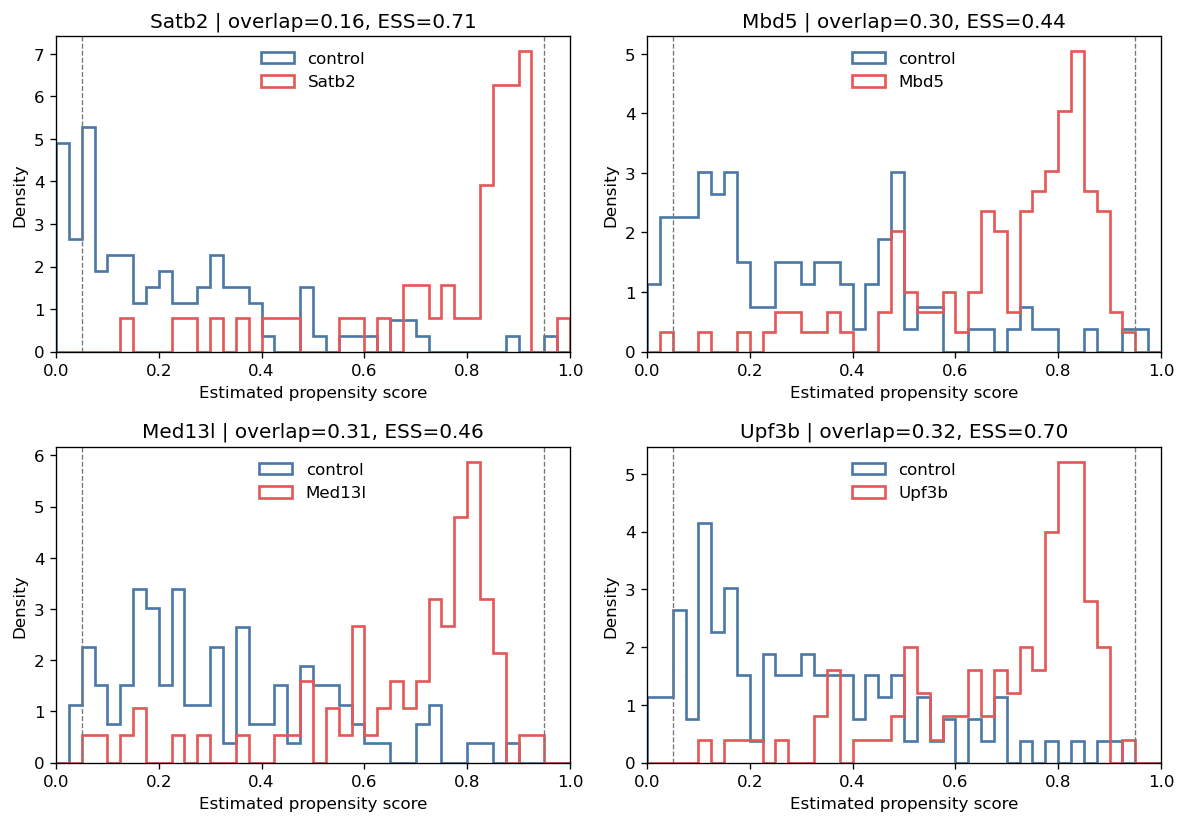
Satb2 has the weakest overlap: its latent-factor diagnostics flag both
U8 and U9, and standardized log-library size is strongly associated with
it as well. Propensity scores are fit one treatment at a time against
the shared controls, so you can change the model for Satb2 alone and
leave the other 28 perturbations untouched. refit_propensity_scores
refits only the treatments you name and returns an audit table next to
the updated scores. Four alternatives:
drop U9 — remove the single most imbalanced latent factor;
drop U8 — remove the other flagged latent factor instead;
10x library penalty — keep every covariate, but apply ten times the usual L2 penalty to standardized log-library size;
Satb2 C=0.1 — keep every covariate and shrink all of them more strongly.
Out-of-fold scores drive the overlap diagnostics; the analysis scores
then reuse the primary fit’s cached Y_hat, so no outcome model is
refitted.
satb2_variants <- list(
  `drop U9` = list(drop_by_treatment = list(Satb2 = "U9")),
  `drop U8` = list(drop_by_treatment = list(Satb2 = "U8")),
  `10x library penalty` = list(
    penalty_factors_by_treatment = list(Satb2 = list(log_library_size = 10))
  ),
  `Satb2 C=0.1` = list(drop_by_treatment = list(Satb2 = list()), C = 0.1)
)

refit_satb2 <- function(pi_hat, K, options) {
  do.call(causarray$refit_propensity_scores, c(
    list(A, W_A, pi_hat = pi_hat, covariate_names = propensity_names,
         K = K, class_weight = "balanced", random_state = 0L),
    options
  ))
}

# Out-of-fold scores drive the overlap diagnostics.
oof_variants <- lapply(satb2_variants, function(options) {
  refit_satb2(pi_oof, 5L, options)
})

do.call(rbind, lapply(names(oof_variants), function(name) {
  audit <- oof_variants[[name]][[2]]
  data.frame(
    model = name,
    n_retained = audit$n_retained,
    degenerate_design = audit$degenerate_design,
    score_std = round(audit$score_std, 3)
  )
}))
##                 model n_retained degenerate_design score_std
## 1             drop U9         11             FALSE     0.322
## 2             drop U8         11             FALSE     0.319
## 3 10x library penalty         12             FALSE     0.237
## 4         Satb2 C=0.1         12             FALSE     0.239
satb2_row <- function(scores, name) {
  ps <- causarray$summarize_propensity_scores(A, scores, clip_bounds = NULL)
  transform(subset(ps, treatment == "Satb2"), model = name)
}
satb2_overlap <- rbind(
  satb2_row(pi_oof, "all factors"),
  do.call(rbind, lapply(names(oof_variants), function(name) {
    satb2_row(oof_variants[[name]][[1]], name)
  }))
)
satb2_overlap[, c(
  "model", "overlap_ratio", "outside_overlap_fraction",
  "ess_control_fraction", "ess_treated_fraction", "brier_score"
)]
##                   model overlap_ratio outside_overlap_fraction
## 19          all factors     0.1640770              0.140127389
## 194             drop U9     0.1829449              0.133757962
## 191             drop U8     0.3063263              0.159235669
## 192 10x library penalty     0.2678505              0.019108280
## 193         Satb2 C=0.1     0.2881983              0.006369427
##     ess_control_fraction ess_treated_fraction brier_score
## 19            0.39460758            0.7139198  0.09675578
## 194           0.40253157            0.7118361  0.09634972
## 191           0.03946558            0.5626148  0.13959208
## 192           0.72319682            0.7921308  0.13735058
## 193           0.62651508            0.8133949  0.14627507
regularized_plot <- causarray$plot_propensity_scores(
A, oof_variants[["Satb2 C=0.1"]][[1]],
treatments = list("Satb2"), clip_bounds = NULL
)
invisible(regularized_plot[[1]]$suptitle(
"Satb2 after C=0.1 regularization", y = 1.02
))
regularized_plot[[1]]$savefig(
"perturbseq-r_files/figure-markdown_github/satb2-c01-regularized-1.png",
dpi = 120L, bbox_inches = "tight"
)
knitr::asis_output(
""
)
# Analysis scores reuse the cached outcome model, so no outcome model is refitted.
satb2_all <- subset(
  df_res, trt == "Satb2", select = c(gene_names, tau, padj)
)
names(satb2_all)[-1] <- c("tau_all", "padj_all")

sensitivity_summary <- do.call(rbind, lapply(names(satb2_variants), function(name) {
  analysis <- refit_satb2(estimation[["pi_hat_raw"]], 1L, satb2_variants[[name]])
  fit <- causarray$LFC(
    Y, cbind(X, U), A, W_A,
    offset = offsets, usevar = "pooled",
    Y_hat = estimation[["Y_hat"]], pi_hat = analysis[[1]]
  )
  alternative <- subset(
    fit[[1]], trt == "Satb2", select = c(gene_names, tau, padj)
  )
  merged <- merge(satb2_all, alternative, by = "gene_names")
  data.frame(
    model = name,
    effect_correlation = cor(merged$tau_all, merged$tau),
    median_absolute_change = median(abs(merged$tau_all - merged$tau)),
    discoveries = sum(merged$padj < 0.1, na.rm = TRUE)
  )
}))
sensitivity_summary$discoveries_all <- sum(satb2_all$padj_all < 0.1, na.rm = TRUE)
sensitivity_summary
##                 model effect_correlation median_absolute_change discoveries
## 1             drop U9          0.9997653            0.004004453        1852
## 2             drop U8          0.8397405            0.183987949         653
## 3 10x library penalty          0.9966004            0.011748283        1775
## 4         Satb2 C=0.1          0.9817849            0.024269803        1568
##   discoveries_all
## 1            1858
## 2            1858
## 3            1858
## 4            1858
baseline_overlap <- subset(satb2_overlap, model == "all factors")
u9_overlap <- subset(satb2_overlap, model == "drop U9")
u8_overlap <- subset(satb2_overlap, model == "drop U8")
penalty_overlap <- subset(satb2_overlap, model == "10x library penalty")
ridge_overlap <- subset(satb2_overlap, model == "Satb2 C=0.1")
u9_effects <- subset(sensitivity_summary, model == "drop U9")
u8_effects <- subset(sensitivity_summary, model == "drop U8")
penalty_effects <- subset(sensitivity_summary, model == "10x library penalty")
ridge_effects <- subset(sensitivity_summary, model == "Satb2 C=0.1")
What the four variants show. Which factor you drop matters, and neither single drop is the answer.
Dropping U9 — the single most imbalanced factor — does essentially nothing: overlap barely moves (0.164 to 0.183, still below the 0.25 floor, so it does not fix the problem) and the effects are unchanged (correlation 1.000). Dropping U8 instead looks like a win — overlap jumps to 0.306 — but it guts the control effective sample size, from 39.5% to 3.9%, and destabilises the effects (correlation 0.840, discoveries 653); a high overlap ratio bought this way is misleading, because the estimate now rests on almost no effective controls. That collapse is a weight problem: dropping U8 pushes a few control cells to propensity scores near 1, so their \(1/(1-\hat{\pi}_i)\) control weights become extreme and a handful of controls dominate the arm. So the message is not “drop U9, keep U8”: dropping U9 fixes nothing and dropping U8 does real damage. Factor-dropping is the wrong tool here — keep all the factors and regularise instead.
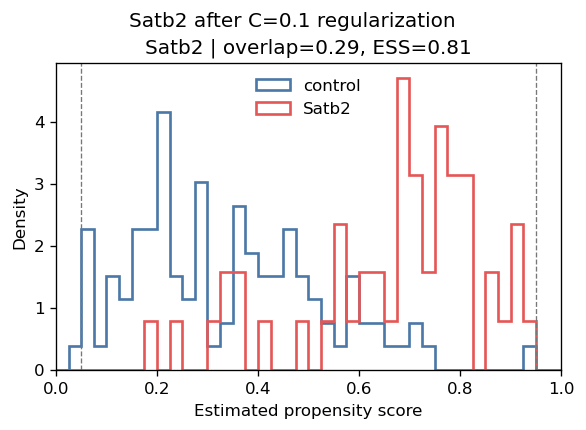
Penalising the propensity model is reliable. The feature-specific 10x
library-size penalty (overlap 0.268) and, more simply, global C = 0.1
both raise overlap above the 0.25 rule of thumb and in line with the
other perturbations. C = 0.1 reaches 0.288, leaves only 0.6% of scores
outside [0.05, 0.95], and keeps the effective sample sizes healthy
(control 62.7%, treated 81.3%) while the effects stay stable
(correlation 0.982). The only real cost is a modest rise in the
out-of-fold Brier score, from 0.097 to 0.146.
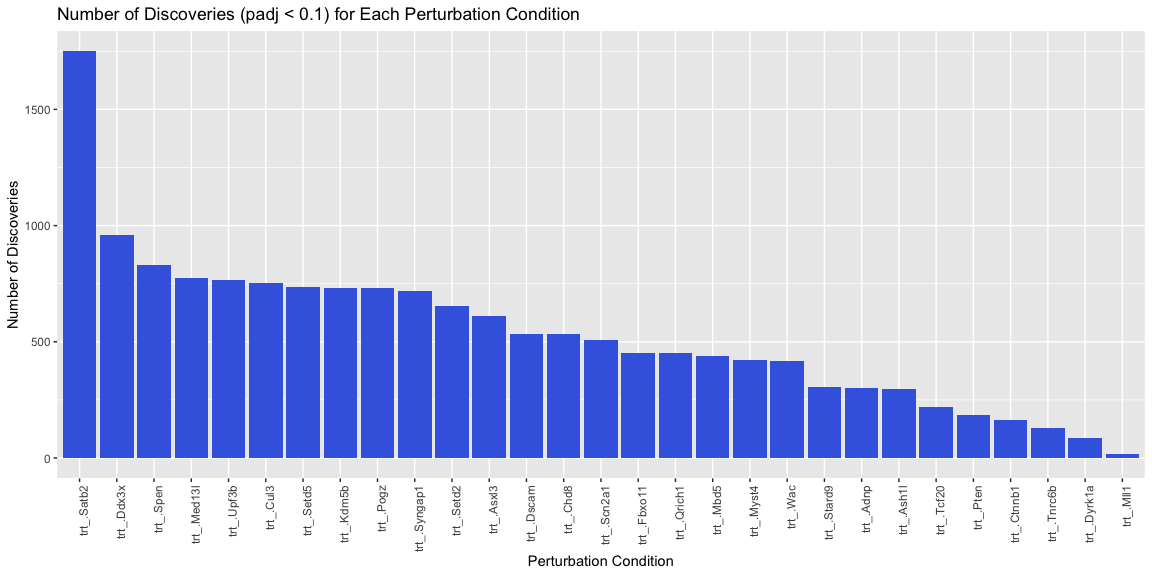
For a small treatment (51 cells) this is a good trade. A penalised model deliberately accepts a little bias in return for propensity scores that are less variable and better supported, which makes the downstream estimate more trustworthy — exactly the overlapping, in-range scores reviewers ask for. The drop in discoveries (1,858 to 1,568) is not a loss: a conservative, well-supported list is the goal, not the largest one.
In practice, applying C = 0.1 to every perturbation is a sensible
default. It gives up a little power on the well-behaved perturbations
but spares you from hand-tuning the few problem cases like Satb2 — a
good bargain when you have many analyses to run.
library(dplyr)
##
## Attaching package: 'dplyr'

## The following objects are masked from 'package:stats':
##
##     filter, lag

## The following objects are masked from 'package:base':
##
##     intersect, setdiff, setequal, union
library(ggplot2)

# Filter the results for significant discoveries
significant_discoveries <- df_res[df_res$padj < 0.1, ]

# Count the number of discoveries for each perturbation condition
discovery_counts <- as.data.frame(table(significant_discoveries$trt))
colnames(discovery_counts) <- c('Perturbation', 'Count')

# Order the discovery_counts by Count in descending order
discovery_counts <- discovery_counts %>% arrange(desc(Count))

# Set the factor levels of Perturbation to ensure ggplot respects the order
discovery_counts$Perturbation <- factor(discovery_counts$Perturbation, levels = discovery_counts$Perturbation)

# Plot the number of discoveries for each perturbation condition
ggplot(discovery_counts, aes(x = Perturbation, y = Count)) +
  geom_bar(stat = "identity", fill = "royalblue") +  theme(axis.text.x = element_text(angle = 90, hjust = 1)) +
  ggtitle('Number of Discoveries (padj < 0.1) for Each Perturbation Condition') +
  xlab('Perturbation Condition') +
  ylab('Number of Discoveries')