 .
.
Batch-wise causarray Analysis — Replogle-E-K562#
This tutorial runs the batch fitting workflow of causarray on a subset of the Replogle et al. 2022 genome-wide CRISPRi screen in K562 cells (Cell 2022), then compares the result with a marginal Wilcoxon test and inspects the propensity model behind it.
Data. The full screen has 309,915 cells × 8,563 genes and 2,021 perturbations. prep_tutorial_data.py keeps the 200 most abundant perturbations plus 2,000 non-targeting control cells, giving 79,865 cells.
Why batch fitting? Fitting fit_gcate on all cells at once means a design with 200 treatment columns, which is both numerically difficult and memory-intensive. gcate_lfc_batch instead pairs each batch of 15 perturbations with a fixed control pool, so peak memory depends on one batch rather than on the total perturbation count.
replogle_subset.h5ad
  |-- prep_causarray_data  ->  Y, A, X, X_A
       |-- gcate_lfc_batch ->  df_res  (tau, std, stat, pvalue, padj per gene × pert)
            |-- volcano, discovery counts, Wilcoxon comparison, propensity diagnostics
Sections 5.4 and 5.5 additionally require the optional
crispyxpackage and the local cache written bycache_propensity_batch.py.
[1]:
import sys
sys.path.insert(0, '../../..')

import time
from pathlib import Path
import numpy as np
import pandas as pd
import scipy.sparse as sp
import matplotlib.pyplot as plt
import scanpy as sc

from causarray import prep_causarray_data, gcate_lfc_batch, align_test_mask
from causarray.gcate import plot_r

import causarray
print('causarray version:', causarray.__version__)
causarray version: 0.0.9
1. Load data#
prep_tutorial_data.py built the subset: the 200 perturbations with the most cells, plus 2,000 non-targeting control cells.
[2]:
adata = sc.read_h5ad('replogle_subset.h5ad')
print(adata)

CTRL_LABEL = adata.uns['ctrl_label']   # 'non-targeting'
PERT_COL   = adata.uns['pert_col']     # 'gene'

vc = adata.obs[PERT_COL].value_counts()
print(f'\nCtrl cells  : {vc[CTRL_LABEL]}')
print(f'Pert cells  : {vc.drop(CTRL_LABEL).sum():,}  across {len(vc) - 1} perturbations')
print(f'Cells/pert  : median {vc.drop(CTRL_LABEL).median():.0f}, '
      f'range {vc.drop(CTRL_LABEL).min()}-{vc.drop(CTRL_LABEL).max()}')
AnnData object with n_obs × n_vars = 79865 × 8563
    obs: 'batch', 'gene', 'gene_id', 'transcript', 'gene_transcript', 'guide_id', 'percent_mito', 'UMI_count', 'z_gemgroup_UMI', 'core_scale_factor', 'core_adjusted_UMI_count', 'disease', 'cancer', 'cell_line', 'sex', 'age', 'perturbation', 'organism', 'perturbation_type', 'tissue_type', 'ncounts', 'ngenes', 'nperts', 'percent_ribo'
    var: 'chr', 'start', 'end', 'class', 'strand', 'length', 'in_matrix', 'mean', 'std', 'cv', 'fano', 'ensembl_id', 'ncounts', 'ncells'
    uns: 'ctrl_label', 'pert_col'

Ctrl cells  : 2000
Pert cells  : 77,865  across 200 perturbations
Cells/pert  : median 346, range 273-1996
2. Prepare causarray inputs#
prep_causarray_data caps every count at the 99.9th percentile of the per-gene maxima, prepends an intercept column, and appends a standardized log library size to the propensity design X_A.
[3]:
Y_raw = adata.X.toarray() if sp.issparse(adata.X) else np.array(adata.X)
Y = pd.DataFrame(Y_raw, columns=adata.var_names.tolist())
del Y_raw

A = (pd.get_dummies(adata.obs[PERT_COL].astype(str), drop_first=False)
       .drop(columns=[CTRL_LABEL]))

Y, A, X, X_A = prep_causarray_data(Y, A)

print(f'Y : {Y.shape}  (cells x genes)')
print(f'A : {A.shape}  (cells x perturbations)')
print(f'X : {X.shape}  X_A : {X_A.shape}')
Y : (79865, 8563)  (cells x genes)
A : (79865, 200)  (cells x perturbations)
X : (79865, 1)  X_A : (79865, 2)
3. Number of latent factors#
r is selected by the JIC criterion from estimate_r. Pre-computed values are loaded from replogle-r.csv; re-run estimate_r_replogle.py to reproduce them.
Why estimate r on control cells?
estimate_rfits GCATE internally, which is expensive at full scale (79,865 cells). The latent factors capture confounding variation that is already present in the baseline transcriptome, so a control-heavy subsample is far cheaper and selects essentially the samer. Passmax_cellsto reproduce this directly — control cells are prioritized automatically:df_r = estimate_r(Y, X, A, r_values, family='nb', max_cells=6000)
[4]:
df_r = pd.read_csv('replogle-r.csv')
fig = plot_r(df_r)
plt.tight_layout()
plt.show()

best_r = int(df_r.loc[df_r['JIC'].idxmin(), 'r'])
print(f'\nSelected r = {best_r}  (min JIC)')
print(df_r.to_string(index=False))
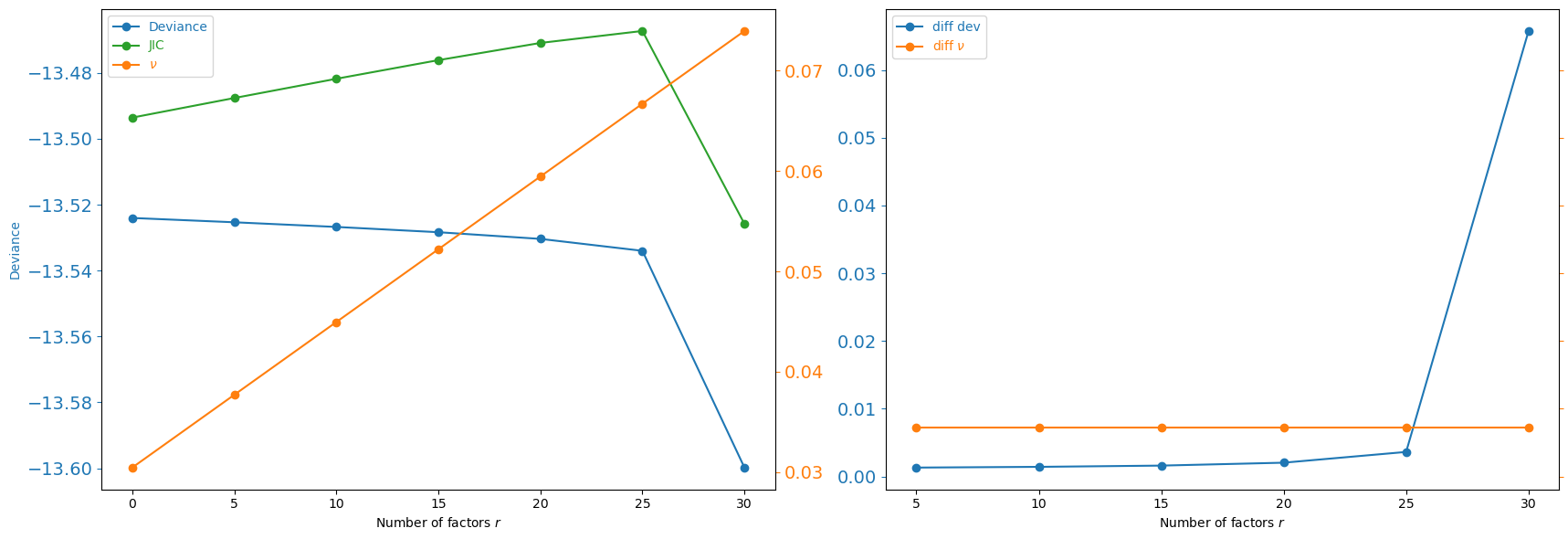
Selected r = 30  (min JIC)
 r   deviance       nu        JIC
 0 -13.524045 0.030448 -13.493596
 5 -13.525350 0.037698 -13.487652
10 -13.526765 0.044947 -13.481817
15 -13.528364 0.052197 -13.476167
20 -13.530392 0.059447 -13.470945
25 -13.534008 0.066696 -13.467311
30 -13.599773 0.073946 -13.525827
4. Batch fitting with gcate_lfc_batch#
Parameter |
Value |
Effect |
|---|---|---|
|
15 |
~15 perturbations per GCATE call |
|
2000 |
≤ 2000 perturbed cells per batch (controls added on top) |
|
2000 |
Fixed control subsample shared across all batches |
|
|
Welch treatment/control variance for inference |
|
|
Resume from disk if interrupted |
With 200 perturbations and batch_size=15, gcate_lfc_batch uses n_batches = ceil(200 / 15) = 14 and splits the remainder evenly with numpy.array_split, giving 4 batches of 15 and 10 batches of 14 rather than a tiny tail batch. Each batch holds at most 2,000 control + 2,000 perturbed cells.
[5]:
R = best_r

t0 = time.perf_counter()
df_res = gcate_lfc_batch(
    Y, X, A, R,
    W_A=X_A,
    batch_size=15,
    max_cells=2000,
    n_ctrl=2000,
    family='nb',
    lfc_kwargs=dict(usevar='unequal'),
    cache_path='replogle_results.h5',
    random_state=0,
    verbose=True,
    gcate_kwargs=dict(
        kwargs_es_1=dict(rel_tol=2e-4, max_iters=30),
        kwargs_es_2=dict(rel_tol=2e-4, max_iters=30),
    ),
)
t_total = time.perf_counter() - t0

print(f'\nTotal wall time: {t_total/60:.1f} min')
print(f'Result shape   : {df_res.shape}')
df_res.head()
[gcate_lfc_batch] Resuming: 14 batches already cached in 'replogle_results.h5'
'Pre-estimating dispersion on ctrl cell subsample...'
GCATE batches: 100%|██████████| 14/14 [00:00<00:00, 150179.68batch/s]
Total wall time: 0.1 min
Result shape   : (1712600, 16)
[5]:
| gene_names | tau | std | log2fc | log2fc_se | stat | rej | pvalue | padj | pvalue_emp_null_adj | padj_emp_null_adj | mean_control | mean_treated | estimable | trt | batch | |
|---|---|---|---|---|---|---|---|---|---|---|---|---|---|---|---|---|
| 0 | LINC01409 | 0.000000 | inf | 0.000000 | inf | NaN | 0.0 | NaN | NaN | NaN | NaN | 0.072352 | 0.078497 | True | AATF | 0 |
| 1 | LINC01128 | -0.130575 | 2.677546 | -0.188380 | 3.862882 | -0.048767 | 0.0 | 0.961208 | 0.972917 | 0.667758 | 0.999905 | 0.156995 | 0.137778 | True | AATF | 0 |
| 2 | NOC2L | 0.017141 | 0.247328 | 0.024729 | 0.356819 | 0.069305 | 0.0 | 0.944891 | 0.972917 | 0.826848 | 0.999905 | 0.824667 | 0.838924 | True | AATF | 0 |
| 3 | KLHL17 | 0.000000 | inf | 0.000000 | inf | NaN | 0.0 | NaN | NaN | NaN | NaN | 0.077686 | 0.084759 | True | AATF | 0 |
| 4 | HES4 | 0.000000 | inf | 0.000000 | inf | NaN | 0.0 | NaN | NaN | NaN | NaN | 0.137674 | 0.134297 | True | AATF | 0 |
5. Results#
5.1 Discovery summary#
[6]:
FDR = 0.05
sig = df_res[df_res['padj'] < FDR]

print(f'Significant (padj < {FDR}): {len(sig):,} gene x pert pairs')
print(f'  Perturbations with >= 1 hit: {sig["trt"].nunique()}')
print(f'  Unique genes affected      : {sig["gene_names"].nunique():,}')

disc_per_pert = sig.groupby('trt').size().sort_values(ascending=False)
print(f'\nTop-10 perts by discovery count:')
print(disc_per_pert.head(10).to_string())
Significant (padj < 0.05): 20,450 gene x pert pairs
  Perturbations with >= 1 hit: 162
  Unique genes affected      : 3,831

Top-10 perts by discovery count:
trt
SUPT5H    1878
SUPT6H    1340
SFPQ       854
CSE1L      740
DDX47      561
HSPA9      547
PSMD6      509
NCBP2      496
TSR2       452
MED12      420
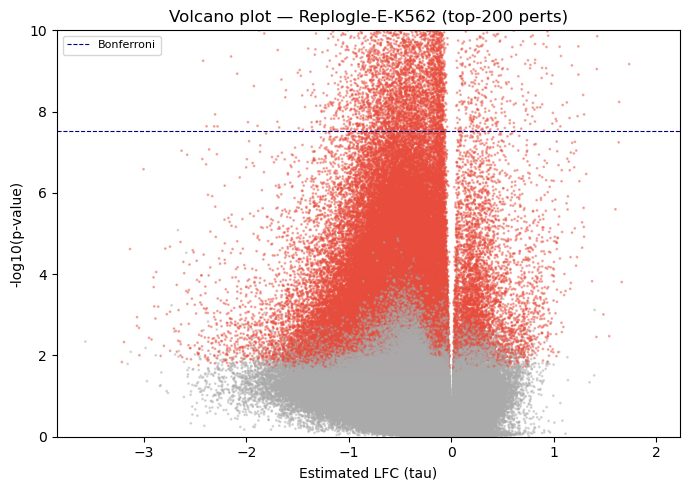
5.2 Volcano plot (all perturbations combined)#
[7]:
fig, ax = plt.subplots(figsize=(7, 5))

colors = np.where(df_res['padj'] < FDR, '#e74c3c', '#aaaaaa')
ax.scatter(
    df_res['tau'], -np.log10(df_res['pvalue'].clip(1e-300)),
    c=colors, s=1, alpha=0.4, rasterized=True,
)
ax.axhline(-np.log10(0.05 / len(df_res)), color='navy', lw=0.8, ls='--',
           label='Bonferroni')
ax.set_ylim(0, 10)
ax.set_xlabel('Estimated LFC (tau)')
ax.set_ylabel('-log10(p-value)')
ax.set_title('Volcano plot — Replogle-E-K562 (top-200 perts)')
ax.legend(fontsize=8)
plt.tight_layout()
plt.show()
5.3 Discovery count per perturbation#
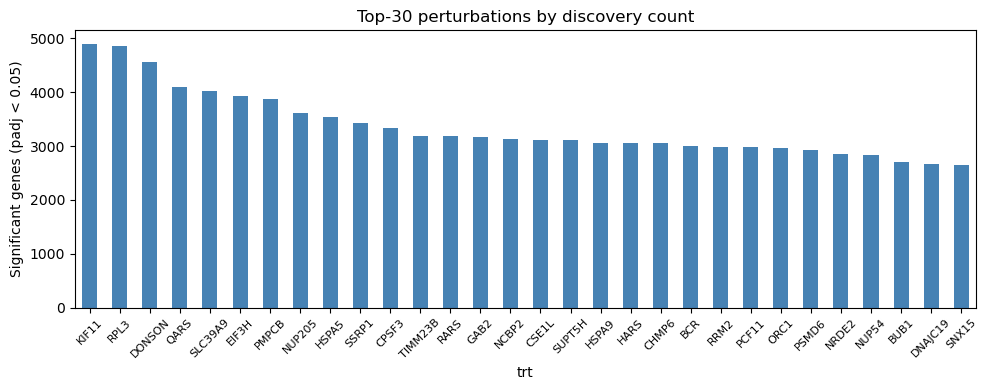
Each bar is the number of significant genes (BH-adjusted p < 0.05) for one perturbation. Because causarray deconfounds shared latent variation before testing, the wide variation mostly reflects real differences in perturbation strength rather than technical artefacts.
[8]:
top_n = 30
top_disc = disc_per_pert.head(top_n)

fig, ax = plt.subplots(figsize=(10, 4))
top_disc.plot(kind='bar', ax=ax, color='steelblue', edgecolor='none')
ax.set_ylabel(f'Significant genes (padj < {FDR})')
ax.set_title(f'Top-{top_n} perturbations by discovery count')
ax.tick_params(axis='x', rotation=45, labelsize=8)
plt.tight_layout()
plt.show()
5.4 Comparison with a marginal Wilcoxon test#
As a reference point, each perturbation is also compared with the pooled non-targeting controls using a Wilcoxon rank-sum test on library-size-normalized, log1p counts (via the optional crispyx package). Both methods are summarized at BH-adjusted p < 0.05.
Wilcoxon is marginal: unlike causarray it adjusts for neither the observed covariates nor the estimated latent factors. Gaps in discovery counts can therefore reflect confounding, model assumptions, filtering, or power, and do not by themselves mark discoveries as true or false.
[9]:
import crispyx

# Wilcoxon is applied to normalized, log-transformed counts, following the
# same convention as the Adamson tutorial.
norm_path = Path('replogle_subset_norm.h5ad')
if not norm_path.exists():
    crispyx.normalize_total_log1p(
        'replogle_subset.h5ad', output_path=str(norm_path), verbose=False
    )
wc_result = crispyx.wilcoxon_test(
    str(norm_path),
    perturbation_column=PERT_COL,
    control_label=CTRL_LABEL,
    verbose=False,
)

wc_count_map = {
    str(pert): int((np.asarray(wc_result[pert].pvalue_adj) < FDR).sum())
    for pert in wc_result.groups
}
all_perts = pd.Index(A.columns.astype(str), name='Perturbation')
comparison_counts = pd.DataFrame(index=all_perts)
comparison_counts['causarray'] = (
    disc_per_pert.rename(index=str).reindex(all_perts, fill_value=0).astype(int)
)
comparison_counts['Wilcoxon'] = (
    pd.Series(wc_count_map).reindex(all_perts, fill_value=0).astype(int)
)
comparison_counts = comparison_counts.sort_values(
    ['Wilcoxon', 'causarray'], ascending=False
)

print(f'causarray: {comparison_counts["causarray"].sum():,} significant pairs')
print(f'Wilcoxon : {comparison_counts["Wilcoxon"].sum():,} significant pairs')
print('Median discoveries per perturbation: ' +
      f'causarray={comparison_counts["causarray"].median():.0f}, ' +
      f'Wilcoxon={comparison_counts["Wilcoxon"].median():.0f}')
display(comparison_counts.head(10))
causarray: 20,450 significant pairs
Wilcoxon : 393,099 significant pairs
Median discoveries per perturbation: causarray=24, Wilcoxon=1979
| causarray | Wilcoxon | |
|---|---|---|
| Perturbation | ||
| SUPT5H | 1878 | 6709 |
| SUPT6H | 1340 | 6384 |
| MED12 | 420 | 5842 |
| MED30 | 292 | 5333 |
| INTS2 | 406 | 5307 |
| HSPA9 | 547 | 5196 |
| MED19 | 361 | 4923 |
| DDX41 | 80 | 4777 |
| PHB2 | 302 | 4661 |
| CSE1L | 740 | 4618 |
Are the extra Wilcoxon hits biologically meaningful?#
Across 8,563 genes, Wilcoxon reports 393,099 significant gene-perturbation pairs (median 1,979 per perturbation) against causarray’s 20,450 (median 24); for SUPT5H the counts are 6,709 and 1,878. List size alone says nothing about quality, so we use direction-specific Gene Ontology enrichment instead. SUPT5H encodes SPT5, a central regulator of RNA polymerase II pausing and elongation, so a broad response is biologically credible.
The two result matrices are first aligned on (perturbation, gene) labels, so that batched row order is never mistaken for biological agreement.
[10]:
wc_groups = pd.Index([str(group) for group in wc_result.groups], name='trt')
wc_genes = pd.Index(wc_result.genes.astype(str), name='gene_names')
wc_lfc = np.asarray(wc_result.logfoldchanges, dtype=float)
wc_padj = np.asarray(wc_result.pvalues_adj, dtype=float)
wc_pts_treated = np.asarray(wc_result.pts, dtype=float)
wc_pts_control = np.asarray(wc_result.pts_rest, dtype=float)

expected = pd.MultiIndex.from_product([wc_groups, wc_genes])
ca_indexed = (
    df_res.assign(
        trt=df_res['trt'].astype(str),
        gene_names=df_res['gene_names'].astype(str),
    ).set_index(['trt', 'gene_names'])
)
if ca_indexed.index.has_duplicates:
    raise ValueError('causarray contains duplicate perturbation-gene tests')
aligned_ca = ca_indexed.reindex(expected)
if aligned_ca['tau'].isna().all():
    raise ValueError('Wilcoxon and causarray results could not be aligned')

ca_lfc = (
    aligned_ca['tau'].to_numpy(dtype=float).reshape(wc_lfc.shape)
    / np.log(2.0)
)
ca_padj = aligned_ca['padj'].to_numpy(dtype=float).reshape(wc_lfc.shape)
ca_estimable = aligned_ca['estimable'].fillna(False).to_numpy().reshape(wc_lfc.shape)
wc_reject = wc_padj < FDR
ca_reject = ca_padj < FDR
del aligned_ca, ca_indexed, expected

print(f'Aligned {wc_lfc.size:,} perturbation-gene tests.')
Aligned 1,712,600 perturbation-gene tests.
SUPT5H Gene Ontology enrichment#
Up- and down-regulated genes are tested separately, since pooling directions obscures their biological meaning. The background is the 8,563 genes tested by both methods rather than the whole genome. Enrichment power depends on list size, so term p-values cannot certify one DE method as correct.
[11]:
go_result_path = Path('replogle_supt5h_go_results.csv')
supt5h_i = wc_groups.get_loc('SUPT5H')
go_queries = {
    'causarray up': wc_genes[ca_reject[supt5h_i] & (ca_lfc[supt5h_i] > 0)].tolist(),
    'causarray down': wc_genes[ca_reject[supt5h_i] & (ca_lfc[supt5h_i] < 0)].tolist(),
    'Wilcoxon up': wc_genes[wc_reject[supt5h_i] & (wc_lfc[supt5h_i] > 0)].tolist(),
    'Wilcoxon down': wc_genes[wc_reject[supt5h_i] & (wc_lfc[supt5h_i] < 0)].tolist(),
}
if go_result_path.exists():
    go_results = pd.read_csv(go_result_path)
else:
    go_results = sc.queries.enrich(
        go_queries, org='hsapiens',
        gprofiler_kwargs={
            'sources': ['GO:BP'],
            'background': wc_genes.tolist(),
            'no_evidences': False,
        },
    )
    go_results.to_csv(go_result_path, index=False)

go_query_summary = pd.DataFrame({
    'DE_genes': {query: len(genes) for query, genes in go_queries.items()},
    'significant_GO_BP_terms': (
        go_results.loc[go_results['significant']].groupby('query').size()
    ),
}).fillna(0).astype(int)
display(go_query_summary)

go_top = (
    go_results.loc[go_results['significant'] & go_results['term_size'].between(20, 1000)]
    .sort_values(['query', 'p_value'])
    .groupby('query', group_keys=False).head(5)
)
display(go_top[['query', 'name', 'p_value', 'intersection_size', 'query_size']])

if not go_top.empty:
    plotted = go_top.sort_values('p_value', ascending=False).copy()
    plotted['label'] = plotted['name'] + ' — ' + plotted['query']
    colors = plotted['query'].map({
        'causarray up': '#1976d2', 'causarray down': '#64b5f6',
        'Wilcoxon up': '#ef6c00', 'Wilcoxon down': '#ffb74d',
    })
    fig, ax = plt.subplots(figsize=(9, max(4, 0.35 * len(plotted))))
    ax.scatter(
        -np.log10(plotted['p_value'].clip(1e-300)), plotted['label'],
        s=25 + 4 * plotted['intersection_size'], c=colors, alpha=0.8,
    )
    ax.set_xlabel('-log10(g:Profiler adjusted p-value)')
    ax.set_ylabel('')
    ax.set_title('SUPT5H: selected GO Biological Process enrichment')
    fig.tight_layout()
    plt.show()
| DE_genes | significant_GO_BP_terms | |
|---|---|---|
| Wilcoxon down | 6163 | 0 |
| Wilcoxon up | 546 | 22 |
| causarray down | 1501 | 79 |
| causarray up | 377 | 0 |
| query | name | p_value | intersection_size | query_size | |
|---|---|---|---|---|---|
| 5 | Wilcoxon up | cytoplasmic translation | 4.640981e-30 | 66 | 510 |
| 15 | Wilcoxon up | translation | 8.293321e-15 | 90 | 510 |
| 16 | Wilcoxon up | protein biosynthetic process | 8.293321e-15 | 90 | 510 |
| 18 | Wilcoxon up | proton transmembrane transport | 1.983633e-11 | 36 | 510 |
| 26 | Wilcoxon up | monoatomic cation transport | 5.623571e-08 | 60 | 510 |
| 0 | causarray down | translation | 2.439314e-47 | 238 | 1441 |
| 1 | causarray down | protein biosynthetic process | 2.439314e-47 | 238 | 1441 |
| 2 | causarray down | ribonucleoprotein complex biogenesis | 6.807785e-42 | 197 | 1441 |
| 3 | causarray down | cytoplasmic translation | 6.828707e-36 | 111 | 1441 |
| 4 | causarray down | ribosome biogenesis | 8.173859e-33 | 142 | 1441 |
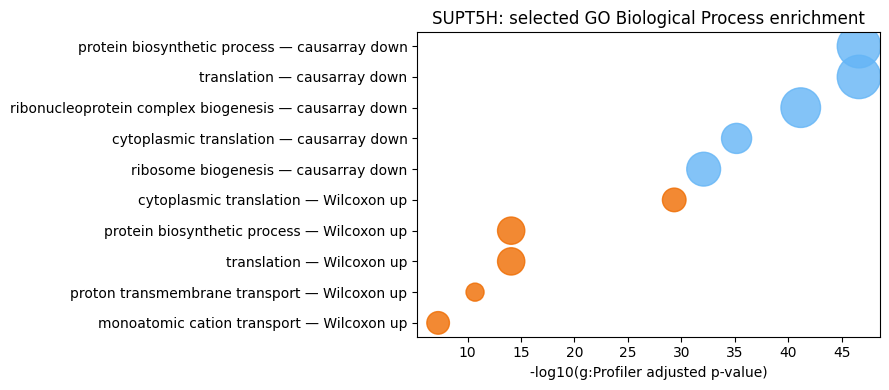
In the cached analysis, the causarray down-regulated list is strongly enriched for translation, ribosome biogenesis, and rRNA processing, and the smaller Wilcoxon up-regulated list for cytoplasmic translation and mitochondrial energy production. The very large Wilcoxon down-regulated list yields no significant GO Biological Process term against this restricted background, which is a signature of list saturation rather than absent biology. causarray thus gives a more selective list of coherent adjusted responses, although enrichment alone cannot show that individual Wilcoxon-only discoveries are false.
Effect-size agreement and extreme Wilcoxon effects#
Marginal log2 fold changes grow very large when a gene is nearly absent in one group, where the value depends strongly on the pseudocount. The full-range panel exposes those points; the zoomed panel makes agreement in the central range visible. Colors mark which methods reject at the common 5% FDR threshold.
[12]:
selected_perts = ['SRRT', 'MED30', 'INTS2']
category_colors = {
    'Neither': '#bdbdbd',
    'Wilcoxon only': '#64b5f6',
    'causarray only': '#ffb74d',
    'Both': '#ef5350',
}

def plot_lfc_comparison(limits=None):
    fig, axes = plt.subplots(1, len(selected_perts), figsize=(15.5, 4.8))
    for ax, perturbation in zip(axes, selected_perts):
        i = wc_groups.get_loc(perturbation)
        x, y = wc_lfc[i], ca_lfc[i]
        finite = np.isfinite(x) & np.isfinite(y)
        categories = np.select(
            [
                wc_reject[i] & ca_reject[i],
                wc_reject[i] & ~ca_reject[i],
                ~wc_reject[i] & ca_reject[i],
            ],
            ['Both', 'Wilcoxon only', 'causarray only'],
            default='Neither',
        )
        for category, color in category_colors.items():
            keep = finite & (categories == category)
            ax.scatter(
                x[keep], y[keep], s=7 if category == 'Neither' else 11,
                alpha=0.22 if category == 'Neither' else 0.55,
                color=color, edgecolors='none', rasterized=True,
                label=f'{category} (n={keep.sum():,})',
            )
        extreme = finite & (x < -5)
        if extreme.any():
            ax.scatter(
                x[extreme], y[extreme], s=55, facecolors='none',
                edgecolors='black', linewidths=0.9, zorder=5,
            )
            for gene, xv, yv in zip(wc_genes[extreme], x[extreme], y[extreme]):
                ax.annotate(gene, (xv, yv), xytext=(4, 4),
                            textcoords='offset points', fontsize=7)
        pearson = np.corrcoef(x[finite], y[finite])[0, 1]
        spearman = pd.Series(x[finite]).corr(pd.Series(y[finite]), method='spearman')
        ax.axhline(0, color='#777777', linewidth=0.7)
        ax.axvline(0, color='#777777', linewidth=0.7)
        ax.axvline(-5, color='black', linestyle='--', linewidth=0.8)
        if limits is not None:
            ax.set_xlim(limits)
            ax.set_ylim(limits)
        ax.set_title(
            f'{perturbation}\nn={finite.sum():,}, r={pearson:.2f}, rho={spearman:.2f}'
        )
        ax.set_xlabel('Wilcoxon log2FC')
        ax.set_ylabel('causarray log2FC')
        ax.legend(fontsize=6.5, frameon=False, loc='best')
    suffix = ' (central range)' if limits is not None else ''
    fig.suptitle('Wilcoxon versus causarray effects' + suffix)
    fig.tight_layout()
    return fig, axes

plot_lfc_comparison()
plt.show()
plot_lfc_comparison(limits=(-3, 3))
plt.show()
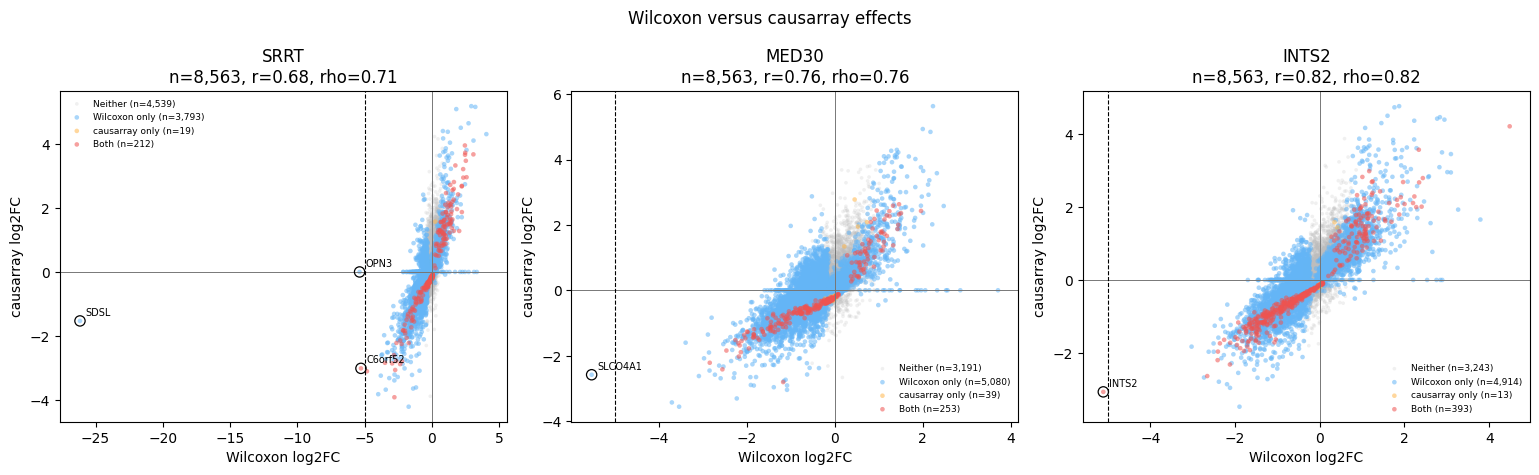
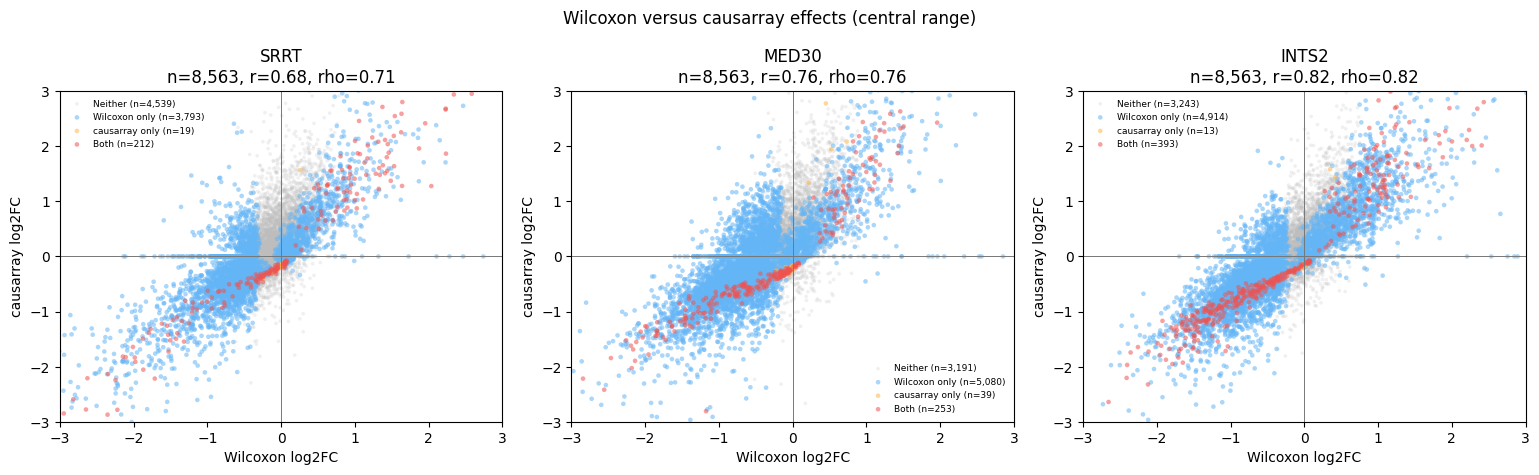
Tests with Wilcoxon log2FC below -5#
Detection counts make the support in each group explicit. Direct targets are flagged, because strong depletion of the perturbed gene itself is biologically expected.
[13]:
group_counts = adata.obs[PERT_COL].astype(str).value_counts()
treated_sizes = np.asarray([group_counts[group] for group in wc_groups])[:, None]
control_size = int(group_counts[CTRL_LABEL])
treated_detected = np.rint(wc_pts_treated * treated_sizes).astype(int)
control_detected = np.rint(wc_pts_control * control_size).astype(int)
extreme_positions = np.argwhere(wc_lfc < -5)

extreme_rows = []
for i, j in extreme_positions:
    if wc_reject[i, j] and ca_reject[i, j]:
        decision = 'Both'
    elif wc_reject[i, j]:
        decision = 'Wilcoxon only'
    elif ca_reject[i, j]:
        decision = 'causarray only'
    else:
        decision = 'Neither'
    extreme_rows.append({
        'perturbation': wc_groups[i],
        'gene': wc_genes[j],
        'direct_target': wc_groups[i] == wc_genes[j],
        'treated_detected': f'{treated_detected[i, j]}/{treated_sizes[i, 0]}',
        'control_detected': f'{control_detected[i, j]}/{control_size}',
        'Wilcoxon_log2FC': wc_lfc[i, j],
        'Wilcoxon_padj': wc_padj[i, j],
        'causarray_log2FC': ca_lfc[i, j],
        'causarray_padj': ca_padj[i, j],
        'causarray_estimable': bool(ca_estimable[i, j]),
        'decision': decision,
    })
extreme_tests = pd.DataFrame(extreme_rows).sort_values('Wilcoxon_log2FC')
display(extreme_tests.round({
    'Wilcoxon_log2FC': 3, 'Wilcoxon_padj': 3,
    'causarray_log2FC': 3, 'causarray_padj': 3,
}))
| perturbation | gene | direct_target | treated_detected | control_detected | Wilcoxon_log2FC | Wilcoxon_padj | causarray_log2FC | causarray_padj | causarray_estimable | decision | |
|---|---|---|---|---|---|---|---|---|---|---|---|
| 2 | SRRT | SDSL | False | 0/307 | 153/2000 | -26.157 | 0.0 | -1.526 | 0.705 | True | Wilcoxon only |
| 3 | MED30 | SLCO4A1 | False | 1/288 | 237/2000 | -5.528 | 0.0 | -2.585 | 0.584 | True | Wilcoxon only |
| 0 | SRRT | OPN3 | False | 1/307 | 227/2000 | -5.369 | 0.0 | 0.000 | NaN | True | Wilcoxon only |
| 1 | SRRT | C6orf52 | False | 1/307 | 246/2000 | -5.266 | 0.0 | -3.005 | 0.000 | True | Both |
| 4 | INTS2 | INTS2 | True | 3/354 | 517/2000 | -5.108 | 0.0 | -3.077 | 0.020 | True | Both |
Candidate support rules#
Genes detected in only a handful of cells produce extreme, pseudocount-driven fold changes, so removing genes that are essentially all-zero in one group is standard, conservative practice — not over-filtering. The rules below encode a few such support requirements; align_test_mask attaches any of them to the existing result table without refitting causarray.
[14]:
negative = wc_lfc < 0
higher_expression_detected = np.where(negative, control_detected, treated_detected)
higher_expression_size = np.where(negative, control_size, treated_sizes)
support_masks = {
    'both groups >= 1 detected':
        (treated_detected >= 1) & (control_detected >= 1),
    'both groups >= 3 detected':
        (treated_detected >= 3) & (control_detected >= 3),
    'both groups >= 5 detected':
        (treated_detected >= 5) & (control_detected >= 5),
    'both groups >= 10 detected':
        (treated_detected >= 10) & (control_detected >= 10),
    'both groups >= max(10, 1%)': (
        (treated_detected >= np.maximum(10, np.ceil(0.01 * treated_sizes)))
        & (control_detected >= max(10, int(np.ceil(0.01 * control_size))))
    ),
    'higher-expression group >= max(10, 1%)': (
        higher_expression_detected
        >= np.maximum(10, np.ceil(0.01 * higher_expression_size))
    ),
}

extreme_mask = wc_lfc < -5
rule_rows = []
for rule, keep in support_masks.items():
    removed = ~keep
    rule_rows.append({
        'rule': rule,
        'tests_removed': int(removed.sum()),
        'tests_removed_percent': 100 * removed.mean(),
        'extreme_tests_removed': int((removed & extreme_mask).sum()),
        'Wilcoxon_discoveries_removed': int((removed & wc_reject).sum()),
        'causarray_discoveries_removed': int((removed & ca_reject).sum()),
    })
support_rule_impact = pd.DataFrame(rule_rows)
display(support_rule_impact.round({'tests_removed_percent': 3}))

chosen_rule = 'higher-expression group >= max(10, 1%)'
keep_in_df_res = align_test_mask(
    df_res, support_masks[chosen_rule],
    treatment_names=wc_groups, gene_names=wc_genes,
)
print(f'{keep_in_df_res.sum():,}/{len(keep_in_df_res):,} causarray rows retained')
# Materialize only if needed; no LFC refit is performed:
# df_res_screened = df_res.loc[keep_in_df_res].copy()
| rule | tests_removed | tests_removed_percent | extreme_tests_removed | Wilcoxon_discoveries_removed | causarray_discoveries_removed | |
|---|---|---|---|---|---|---|
| 0 | both groups >= 1 detected | 1 | 0.000 | 1 | 1 | 0 |
| 1 | both groups >= 3 detected | 12 | 0.001 | 4 | 12 | 4 |
| 2 | both groups >= 5 detected | 41 | 0.002 | 5 | 37 | 11 |
| 3 | both groups >= 10 detected | 392 | 0.023 | 5 | 331 | 32 |
| 4 | both groups >= max(10, 1%) | 392 | 0.023 | 5 | 331 | 32 |
| 5 | higher-expression group >= max(10, 1%) | 4 | 0.000 | 0 | 0 | 0 |
1,712,596/1,712,600 causarray rows retained
What the extreme tail shows#
Five of 1,712,600 aligned tests have Wilcoxon log2FC below -5. Wilcoxon rejects all five; causarray rejects two.
All five have at most three treated detections against a median of 237 control detections, and one is the direct INTS2–INTS2 target pair. They are one-sided near-depletions driven by the
1e-9marginal pseudocount, which inflates the numerical fold change when a gene is nearly absent in one group.A simple support rule cleans these up: requiring ten detections in both groups removes all five (392 tests in total), while requiring support only in the higher-expression group removes four tests.
A good analysis aims to be correct and a little conservative, not to maximise discoveries. Filtering the near-empty genes is the sensible default here. Because a rule chosen after seeing the results only subsets existing rows — effect estimates and p-values are untouched — keep the original BH-adjusted values rather than re-running the correction on the surviving subset.
5.5 Propensity-score overlap and per-treatment tuning#
replogle_results.h5 stores result tables only, so this section reproduces a single batch. cache_propensity_batch.py refits batch 12, which contains SUPT5H, SRRT, SUPT6H, and TSR2. Run it once from this directory:
python cache_propensity_batch.py
Everything except the propensity model is held fixed — the cells, latent factors, outcome predictions, and the unequal-variance estimator — so every difference below is caused by the propensity specification alone.
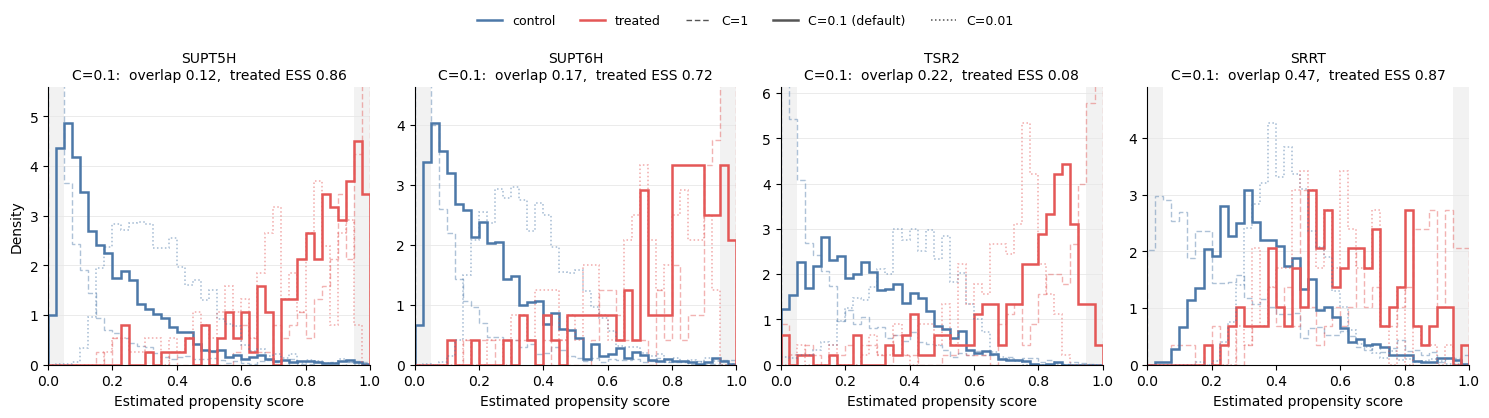
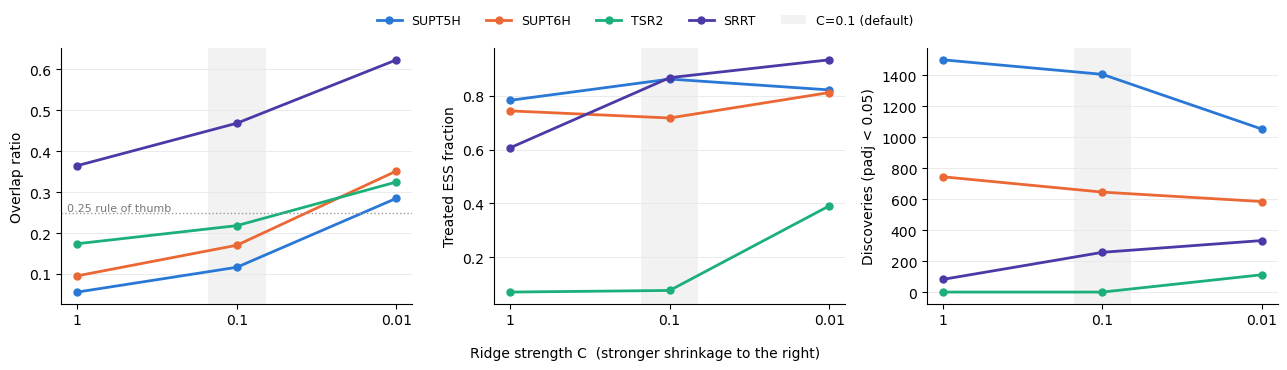
The knob we sweep is the logistic ridge strength C. Following scikit-learn’s convention, C is the inverse regularization strength: smaller C means stronger shrinkage and smoother scores. Two diagnostics are read per treatment:
overlap — how much the treated and control score distributions coincide, from 0 (disjoint) to 1 (identical). Low overlap means the model separates the two groups almost perfectly, leaving little common support on which to compare them.
treated ESS fraction — the effective sample size of the inverse-probability weights, as a fraction of the treated cells. 0.07 means the estimate carries roughly the weight of only 7% of those cells.
ESS is Kish’s effective sample size of the inverse-probability weights, \(\mathrm{ESS} = \left(\sum_i w_i\right)^2 / \sum_i w_i^2\), with \(w_i = 1/\hat{\pi}_i\) for treated cells and \(1/(1-\hat{\pi}_i)\) for controls, reported relative to the group size.
[15]:
ps_summary_path = Path('replogle_propensity_batch12_summary.csv')
ps_tuning_path = Path('replogle_propensity_batch12_tuning.csv')
ps_scores_path = Path('replogle_propensity_batch12_selected_scores.npz')

ps_focus = ['SUPT5H', 'SUPT6H', 'TSR2', 'SRRT']
ridge_labels = {
    'OOF balanced C=1': '1',
    'OOF balanced C=0.1': '0.1',
    'OOF balanced C=0.01': '0.01',
}
ridge_order = ['1', '0.1', '0.01']

grid = (
    pd.read_csv(ps_summary_path)
    .merge(pd.read_csv(ps_tuning_path), on=['model', 'treatment'])
    .query('treatment in @ps_focus and model in @ridge_labels')
    .assign(C=lambda frame: frame['model'].map(ridge_labels))
)
ps_table = (
    grid.pivot(index='treatment', columns='C',
               values=['overlap_ratio', 'ess_treated_fraction', 'discoveries'])
    .reindex(ps_focus)
    .reindex(columns=ridge_order, level='C')
    .round(3)
)
for column in ps_table.columns:
    if column[0] == 'discoveries':
        ps_table[column] = ps_table[column].astype(int)
display(ps_table)
| overlap_ratio | ess_treated_fraction | discoveries | |||||||
|---|---|---|---|---|---|---|---|---|---|
| C | 1 | 0.1 | 0.01 | 1 | 0.1 | 0.01 | 1 | 0.1 | 0.01 |
| treatment | |||||||||
| SUPT5H | 0.056 | 0.117 | 0.285 | 0.784 | 0.863 | 0.822 | 1501 | 1407 | 1053 |
| SUPT6H | 0.096 | 0.170 | 0.352 | 0.744 | 0.718 | 0.812 | 745 | 646 | 585 |
| TSR2 | 0.174 | 0.218 | 0.325 | 0.070 | 0.076 | 0.391 | 0 | 0 | 112 |
| SRRT | 0.365 | 0.469 | 0.623 | 0.607 | 0.868 | 0.934 | 82 | 257 | 333 |
[16]:
from matplotlib.lines import Line2D
from matplotlib.patches import Patch

score_cache = np.load(ps_scores_path)
A_ps = score_cache['A']
ps_perturbations = score_cache['perturbations'].astype(str).tolist()
ps_control = A_ps.sum(axis=1) == 0

# Every curve is out-of-fold, so the panels below and the table above describe
# the same models. Solid marks the default we recommend; the two ends of the
# sweep are drawn faint, as context rather than as the answer.
C_HIGHLIGHT = '0.1'
c_styles = {
    '1':    dict(linestyle=(0, (4, 2)),   linewidth=1.0, alpha=0.45),
    '0.1':  dict(linestyle='-',           linewidth=1.8, alpha=1.00),
    '0.01': dict(linestyle=(0, (1, 1.6)), linewidth=1.1, alpha=0.50),
}
group_colors = {'control': '#4c78a8', 'treated': '#e45756'}

fig, axes = plt.subplots(1, 4, figsize=(15, 4.2), sharex=True)
for ax, perturbation in zip(axes, ps_focus):
    treated = A_ps[:, ps_perturbations.index(perturbation)] == 1
    # Shade outside [0.05, 0.95], the window `outside_overlap_fraction` counts.
    ax.axvspan(0, 0.05, color='#f2f2f2', linewidth=0, zorder=0)
    ax.axvspan(0.95, 1, color='#f2f2f2', linewidth=0, zorder=0)
    tallest = 0.0
    for C in ridge_order:
        scores = score_cache[f'OOF balanced C={C}__{perturbation}']
        for mask, color in ((ps_control, group_colors['control']),
                            (treated, group_colors['treated'])):
            counts, _, _ = ax.hist(scores[mask], bins=40, range=(0, 1),
                                   density=True, histtype='step', color=color,
                                   **c_styles[C])
            if C != '1':
                tallest = max(tallest, counts.max())
    # C=1 separates the groups so sharply that its curves spike at the clipping
    # bounds. Scale the axis to the regularized models and let those spikes run
    # off the top, rather than flattening everything else to accommodate them.
    ax.set_ylim(0, 1.15 * tallest)
    focus = grid[(grid['treatment'] == perturbation)
                 & (grid['C'] == C_HIGHLIGHT)].iloc[0]
    ax.set_title(f'{perturbation}\n'
                 f'C={C_HIGHLIGHT}:  overlap {focus["overlap_ratio"]:.2f},'
                 f'  treated ESS {focus["ess_treated_fraction"]:.2f}',
                 fontsize=10)
    ax.set_xlabel('Estimated propensity score')
    ax.set_xlim(0, 1)
    ax.grid(axis='y', color='#e8e8e8', linewidth=0.6)
    ax.set_axisbelow(True)
    for side in ('top', 'right'):
        ax.spines[side].set_visible(False)
axes[0].set_ylabel('Density')

overlap_handles = [
    Line2D([], [], color=color, linewidth=1.8, label=name)
    for name, color in group_colors.items()
] + [
    Line2D([], [], color='#555555', label=f'C={C}' + (' (default)' if C == C_HIGHLIGHT else ''),
           linestyle=c_styles[C]['linestyle'], linewidth=c_styles[C]['linewidth'])
    for C in ridge_order
]
fig.legend(handles=overlap_handles, loc='upper center', ncol=5, frameon=False,
           bbox_to_anchor=(0.5, 1.0), fontsize=9)
fig.tight_layout(rect=(0, 0, 1, 0.92))
plt.show()

sweep_panels = [
    ('overlap_ratio', 'Overlap ratio', 0.25),
    ('ess_treated_fraction', 'Treated ESS fraction', None),
    ('discoveries', f'Discoveries (padj < {FDR})', None),
]
sweep_colors = ['#2a78d6', '#eb6834', '#1baf7a', '#4a3aa7']

fig, axes = plt.subplots(1, 3, figsize=(13, 3.8), sharex=True)
for ax, (column, label, reference) in zip(axes, sweep_panels):
    ax.axvspan(ridge_order.index(C_HIGHLIGHT) - 0.18,
               ridge_order.index(C_HIGHLIGHT) + 0.18,
               color='#f2f2f2', linewidth=0, zorder=0)
    for color, perturbation in zip(sweep_colors, ps_focus):
        row = (grid[grid['treatment'] == perturbation]
               .set_index('C').reindex(ridge_order))
        ax.plot(ridge_order, row[column], marker='o', markersize=5,
                linewidth=2, color=color, label=perturbation)
    if reference is not None:
        ax.axhline(reference, color='#999999', linestyle=':', linewidth=1)
        ax.text(0.015, reference, f'{reference:g} rule of thumb', fontsize=8,
                color='#777777', va='bottom',
                transform=ax.get_yaxis_transform())
    ax.set_ylabel(label)
    ax.grid(axis='y', color='#e8e8e8', linewidth=0.6)
    ax.set_axisbelow(True)
    for side in ('top', 'right'):
        ax.spines[side].set_visible(False)
sweep_handles, _ = axes[0].get_legend_handles_labels()
sweep_handles.append(Patch(facecolor='#f2f2f2', label=f'C={C_HIGHLIGHT} (default)'))
fig.legend(handles=sweep_handles, loc='upper center', ncol=5, frameon=False,
           bbox_to_anchor=(0.5, 1.0), fontsize=9)
fig.supxlabel('Ridge strength C  (stronger shrinkage to the right)',
              fontsize=10, y=0.06)
fig.tight_layout(rect=(0, 0.03, 1, 0.92))
plt.show()
Reading the diagnostics#
Every curve above is out-of-fold, so the panels and the table describe the same models. Solid curves, and the shaded column in the sweep, mark C=0.1, the default worth reaching for first; the two ends of the sweep are drawn faint. Each panel is scaled to its regularized curves, so where C=1 separates the groups almost perfectly its curves run off the top, piled against the clipping bounds.
Overlap is weak for the strongest perturbations. At C=1 only 5.6% of the SUPT5H score distributions overlap, and 9.6% for SUPT6H. Both perturbations are easy to predict from the latent factors, so the propensity model tells treated and control cells apart almost perfectly.
Stronger shrinkage always improves overlap, but only sometimes improves power.
SUPT5H and SUPT6H already keep most of their treated cells (ESS 78% and 74%), so extra shrinkage only adds bias: discoveries fall from 1,501 to 1,053 and from 745 to 585.
TSR2 is the opposite case. At
C=1its treated ESS is just 7%, meaning the estimate rests on a handful of cells; standard errors inflate 4.4× and it reports no discoveries at all. The defaultC=0.1barely moves it (ESS 8%, still nothing); only atC=0.01does its ESS reach 39% and 112 discoveries appear.
So watch the treated ESS, not the discovery count. When ESS collapses, that treatment is being carried by too few cells and more shrinkage helps. When ESS is already healthy, leave C alone — shrinking it further just trades power for smoother scores.
Because the best choice differs from treatment to treatment, causarray can refit only the treatments you name, reusing the cached outcome predictions:
pi_tuned, audit = refit_propensity_scores(
    A, W_A, pi_hat=estimation['pi_hat_raw'],
    drop_by_treatment={'TSR2': []},   # refit TSR2 alone, keeping every covariate
    C=0.01, K=5,
)
tuned_results, _ = LFC(Y, W, A, W_A, Y_hat=estimation['Y_hat'], pi_hat=pi_tuned)
Calibrated probabilities (class_weight=None) and stronger clipping also raise ESS, but they inflate standard errors 2.3–10.4× here, so neither replaces choosing C.
6. Summary#
gcate_lfc_batchscales causarray to 200 perturbations by pairing batches of 15 with a shared control pool, yielding 20,450 significant gene × perturbation pairs at 5% FDR (median 24 per perturbation).A marginal Wilcoxon test reports about 19× more hits. Direction-specific GO enrichment favours the causarray lists as the more coherent ones, but discovery counts alone cannot decide which method is right.
align_test_maskattaches expression-support rules to an existing result table by label, so such diagnostics never require refitting the LFC.Propensity overlap is weak for the strongest perturbations, and the best ridge strength differs by treatment. Watch the treated ESS, and use
refit_propensity_scoresto tune one treatment at a time without disturbing the rest.